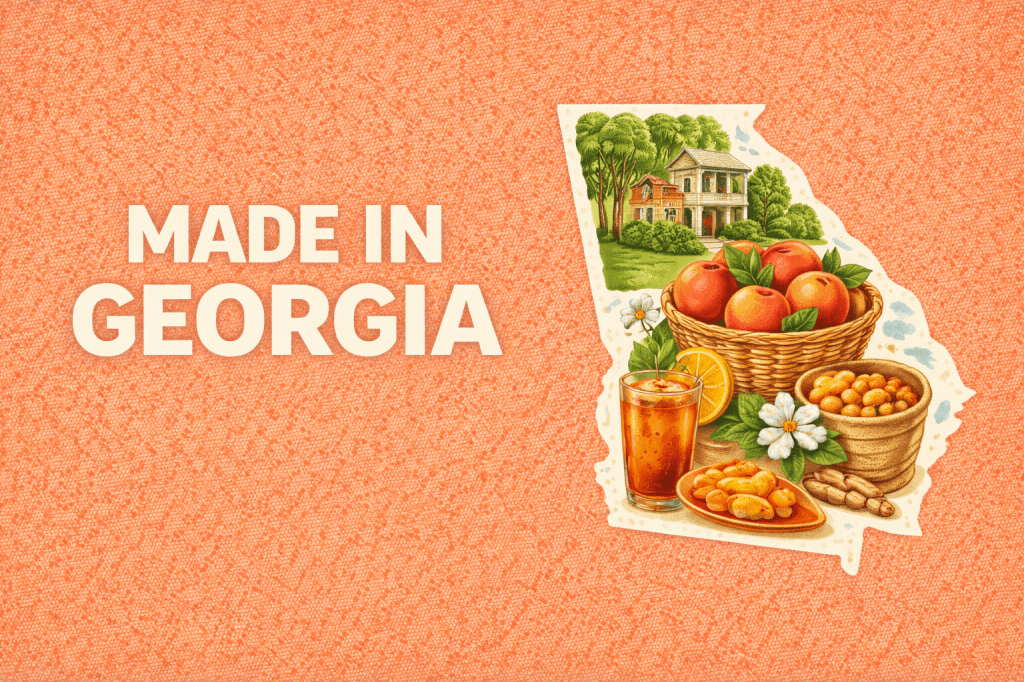
Peach-sweet afternoons, red-clay riverbanks and the salt air off the Atlantic shape Georgia’s senses: the warm, sticky scent of fruit preserves bubbling in downtown kitchens, the rustle of sweetgrass along the Sea Islands, and the smoky tang of coastal fish and mountain bourbon.
From the lowcountry to the Blue Ridge foothills, local ingredients and long-standing techniques give Georgia-made goods their distinct flavor and texture.
Here are the best things truly Made in Georgia, products that reflect its heritage, creativity, and everyday life.
1. Fresh Georgia Peaches & Peach Preserves
Why it’s made here:
Georgia’s sandy-silt soils and long, warm summers produce some of the juiciest freestone peaches in the region. The fruit is a seasonal focal point of farms and roadside stands from middle Georgia to the orchards around Fort Valley.
What to look for:
Buy ripe freestone peaches when in season; for travel-friendly options, choose hand-labeled small-batch peach jam, preserves, or bottlings that name the orchard or county.
Price bracket (2025):
Fresh peaches $3–7 per pound in season; preserves and small-batch jams $8–18 per jar.
Where to find it:
Farmers’ markets, orchard farm stores, roadside stands on back-country highways, and specialty farm shops in small towns.
2. Vidalia Onions & Onion Preserves
Why it’s made here:
Vidalia onions are a registered regional product grown only in a defined area of southeastern Georgia — the warm sandy soils produce their signature sweet, mild flavor.
What to look for:
Look for the Vidalia branding on packaging or tags and ask vendors about the county of origin; pickled or caramelized Vidalia products are popular, too.
Price bracket (2025):
Fresh bulbs $2–5 per pound; jarred onion relishes $6–15. Where to find it:
Roadside stands in the Vidalia region, farm co-ops, and seasonal produce sections at farmers’ markets.
3. Georgia Pecans & Pecan Pralines
Why it’s made here:
Georgia is a top pecan producer; the nut’s buttery texture thrives in southern groves and has long fed a sweets-making tradition from pralines to pecan pies.
What to look for:
Whole local pecans (in-shell or shelled) and small-batch pralines or candied pecans that list local orchards or processors rather than generic packaging.
Price bracket (2025):
Shelled pecans $8–20 per pound; artisanal pralines $2–6 each or $10–25 per box.
Where to find it:
Farmers’ markets, confectioners in historic downtowns, and festival booths at county fairs.
4. Boiled Peanuts
Why it’s made here:
A classic Southern snack, boiled peanuts are made from fresh Georgia green peanuts — steamed with salt and often seasoned with spice — and are an authentic roadside and festival treat.
What to look for:
Fresh, warm tubs at stands or vacuum-packed boiled peanuts labeled with harvest date and farm origin for best quality.
Price bracket (2025):
$4–10 per pint or small tub depending on seasoning and vendor.
Where to find it:
Roadside peanut stands, farmers’ markets, and local gas stations in rural counties during peanut season.
5. Sweetgrass Baskets (Gullah/Geechee)
Why it’s made here:
Coastal Georgia’s Sea Islands are home to Gullah/Geechee communities who maintain the sweetgrass basketry tradition — a living link to West African weaving techniques and local marsh grasses.
What to look for:
Hand-stitched coils of sweetgrass, fine finishing, and a seller who can describe the material (sweetgrass, bulrush) and the maker’s connection to Gullah/Geechee culture.
Price bracket (2025):
Small baskets $40–100; larger market baskets $150–600+ depending on intricacy.
Where to find it:
Coastal craft cooperatives, island galleries, cultural heritage centers, and select festival markets.
6. Cherokee Rivercane Basketry & Beadwork
Why it’s made here:
North Georgia’s Cherokee communities keep rivercane weaving and beadwork alive — traditional materials and motifs are handcrafted into utilitarian and ceremonial pieces.
What to look for:
Tight, even weaving of rivercane, natural pigments, and provenance details; beadwork often follows traditional designs and may be signed by the artist.
Price bracket (2025):
Small baskets and bead pieces $30–150; larger or ceremonial items $200–1,000+.
Where to find it:
Tribal artisan centers, cultural festivals, and museum shops tied to Cherokee heritage sites.
7. North Georgia Wines (Dahlonega & Blue Ridge Vineyards)
Why it’s made here:
Georgia’s cooler mountain elevations and microclimates support small vineyards producing hybrid and vinifera wines — the Dahlonega area and surrounding foothills have an active boutique-winery scene.
What to look for:
Bottles that list the vineyard and vintage, tasting-room-only releases, and grape varieties that suit the climate (e.g., Norton, Chambourcin, Petit Manseng).
Price bracket (2025):
Bottles $15–40 for everyday labels; limited-release bottles $30–75+.
Where to find it:
Winery tasting rooms, vineyard shops, and regional wine trails.
8. Small-Batch Distillery Spirits & Craft “Moonshine”
Why it’s made here:
Georgia has a growing craft-distilling movement making bourbon, rye, and legal moonshine-style corn spirits, often using local grains and mountain spring water.
What to look for:
Distillers’ labels that name the mash bill or farm source, tasting-room-only batches, and clear information about local ingredients and aging.
Price bracket (2025):
Bottles $25–60 for standard releases; single-barrel or aged spirits $60–150+.
Where to find it:
Distillery taprooms, tasting events, and select liquor stores that highlight local producers.
9. Craft Beer from Georgia Breweries
Why it’s made here:
Georgia’s craft-brew scene blends Southern flavor traditions with modern brewing — look for barrel-aged porters, hop-forward IPAs, and beers brewed with local adjuncts like peaches or honey.
What to look for:
Crowler or can labels naming the local brewery, seasonal releases tied to regional ingredients, and brewery taprooms offering onsite cans.
Price bracket (2025):
Single cans $3–8; mixed packs or special releases $12–30. Where to find it:
Brewery taprooms, regional taprooms in city craft districts, and local bottle shops.
10. Alkaline-Glazed Stoneware & Appalachian Pottery
Why it’s made here:
North Georgia potters often draw on Appalachian stoneware traditions — including alkaline glazes and utilitarian forms — using local clays and techniques passed through regional studios.
What to look for:
Subtle glaze variations, the weight of the piece, and maker’s marks; traditional jugs, crocks, and contemporary functional ware show regional clay characteristics.
Price bracket (2025):
Small functional pieces $30–75; larger crocks or artist-signed works $100–500+.
Where to find it:
Pottery studios, craft fairs in mountain communities, and gallery co-ops in historic towns.
11. Dahlonega Gold Jewelry & Gold-Flecked Keepsakes
Why it’s made here:
The Dahlonega area was the site of the first major U.S. gold rush; jewelers in the region sometimes incorporate locally sourced gold flakes or nods to the local mining history in bespoke pieces.
What to look for:
Pieces that note Dahlonega provenance, hallmark stamps, or descriptions that the gold is responsibly sourced from local claims.
Price bracket (2025):
Small gold-accented jewelry $60–250; solid-gold pieces priced by metal weight starting $300+.
Where to find it:
Mountain-town artisan shops, jeweler studios with local provenance statements, and courthouse-square galleries.
12. Tupelo & Wildflower Honey
Why it’s made here:
Coastal river basins and lowcountry forests produce distinctive Tupelo honey and multifloral wildflower honeys prized for their clarity and floral notes.
What to look for:
Honey labeled by floral source and county, small-batch creamed honeys, and raw, minimally processed jars from local beekeepers.
Price bracket (2025):
Small jars $10–30; specialty Tupelo jars $25–60 depending on rarity.
Where to find it:
Farmers’ markets, apiary stands, and specialty food shops connected to regional producers.
13. Smoked Fish & Coastal Preserves
Why it’s made here:
Georgia’s coast supplies shrimp, mullet, and other seafood that local smokehouses turn into preserved specialties — smoked mullet, canned shrimp, and savory fish spreads are coastal staples.
What to look for:
Short ingredient lists, smokehouses that name local docks or vessels, and firm texture with natural smoke flavor rather than excessive additives.
Price bracket (2025):
Smoked fillets $8–25; canned preserves $6–18. Where to find it:
Coastal fish markets, harbor-front smokehouses, and seafood counters in regional towns.
14. Handwoven Textiles & Indigo-Dyed Cloth
Why it’s made here:
Georgia artisans draw on Southern textile history — hand looms and revived indigo dyeing produce throws, tea towels, and wearable textiles reflecting local dye plants and patterns.
What to look for:
Natural indigo hues that vary slightly between pieces, handwoven texture, maker labels, and information on dye source and mordanting techniques.
Price bracket (2025):
Small textiles $30–90; larger throws and blankets $120–450. Where to find it:
Weaving studios, craft fairs, museum textile shops, and slow-fashion boutiques.
Local Makers & Traditions
Georgia’s craft heritage is layered. Coastal Gullah/Geechee basketry and salt-of-the-sea foodways, Cherokee rivercane weaving and beadwork in the north. Appalachian pottery techniques and small mountain distilleries and a long agricultural traditions centered on peaches, pecans, and Vidalia onions.
Many contemporary makers work out of family-run studios, cooperative craft centers, and seasonal markets, preserving techniques while experimenting with modern designs.
Visit tasting rooms in the mountains, watch a basketmaker braid sweetgrass on the coast, or tour a pottery studio to see regional materials and processes in action.
How to Spot Genuine Local Products
- Look for provenance: labels that name the county, orchard, farm, distillery, vineyard, or artisan studio. Georgia Grown or Vidalia marks are reliable indicators for food products.
- Inspect materials and construction: real rivercane or sweetgrass has a natural scent and irregularities; hand-thrown pottery shows tool marks and a potter’s signature; handwoven textiles have minor inconsistencies in weave.
- Ask questions: reputable sellers will explain where ingredients or materials came from, how the piece was made, and who the maker is.
- Beware of red flags: mass-produced sameness, generic “Made in China” tags, or overly glossy packaging without provenance usually indicate imports. For foods, check for short ingredient lists and harvest or canning dates.
Where to Buy Made-in-Georgia Goods
- Farmers’ markets and seasonal roadside stands across the state
- Winery tasting rooms and distillery taprooms in North Georgia and mountain towns
- Coastal craft cooperatives and Gullah/Geechee cultural centers on the Sea Islands
- Heritage festivals, county fairs, and artisan markets held in historic town squares
- Museum shops and gallery co-ops in cities like Savannah and Atlanta
FAQs
Q: Are products in Georgia expensive?
A: Prices vary widely — many farmers’ market foods and small crafts are affordable, while signature artisanal items (large sweetgrass baskets, aged spirits, signed pottery) can be higher-priced. There are good options at all budgets.
Q: How can I tell if something is authentically made here?
A: Ask for the maker’s name or farm, look for local labeling (county, Georgia Grown, Vidalia), check for maker’s marks, and prefer sellers who share production details and allow you to inspect materials.
Q: What is the best made-in-Georgia gift to bring home?
A: Edible gifts like small-batch peach preserves, Vidalia onion relish, pecan pralines, or Tupelo honey travel well; for longer-lasting souvenirs, a sweetgrass basket or a signed piece of regional pottery offers a meaningful connection to place.
Seek out regional flavors and crafts on your next trip to celebrate what’s truly Made in Georgia.
Let me know in the comments if you have any other top ‘what to buy’ ideas!
About the Author
Colin is the founder of SouvenirsIdeas.com and a passionate traveller with a soft spot for ceramics, markets, and food tours. He writes practical, first-hand guides to help you bring home souvenirs that actually mean something — not just more clutter!


 Souvenir Ideas to Take Home from Every Country and City
Leave a comment