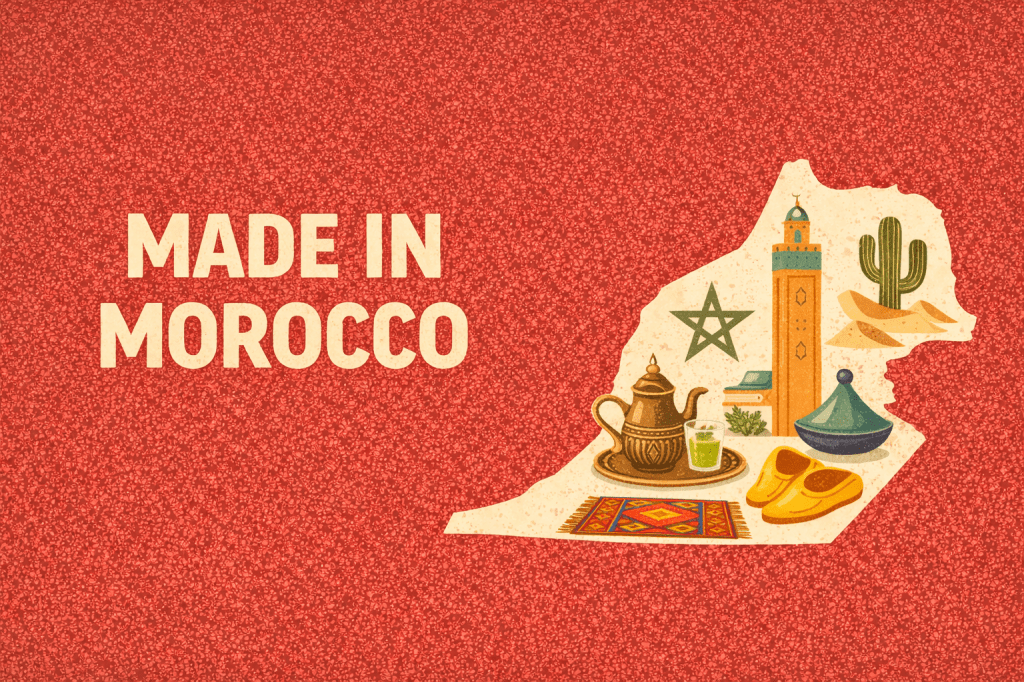
Morocco unfurls between the snow-dusted High Atlas and the Atlantic surf, a place where cedar forests, arid plains and fragrant orchards meet labyrinthine medinas.
Sunlight pools on tadelakt walls, the iron tang of tannery pits rises from Fez, and women’s songs echo through argan groves, the landscape and its materials are woven into every craft, from wool and clay to brass and rose petals.
Here are the best things truly made in Morocco, products that reflect its heritage, creativity, and everyday life, and that signal the authenticity of being Made in Morocco.
1. Beni Ourain Rugs
Why it’s made here:
Handwoven by Berber women in the Middle Atlas and Rif mountains, Beni Ourain rugs use local sheep’s wool and tribal motifs passed down generations; their loft and simple geometric patterns respond to cold mountain nights and nomadic aesthetics.
What to look for:
Thick, natural off-white or cream wool with darker, irregular motifs; hand-knotted pile, slight asymmetry in pattern and fringe; avoid perfectly uniform machine-produced copies.
Price bracket (2025):
$300–$3,500 depending on size, age, knot density and provenance.
Where to find it:
Mountain villages around Azilal and Marrakech/Fez souks, cooperative stores, reputable Marrakech riad workshops.
2. Fes (Fès) Ceramics
Why it’s made here:
Fez is Morocco’s historic ceramic capital — artisans spin and paint sun-dried clay into colorful tajines, bowls and zellige tiles using cobalt blues, greens and intricate arabesque motifs rooted in Andalusi and Moroccan traditions.
What to look for:
Hand-painted brush strokes, tiny glaze variations, stamped workshop marks; raw, unglazed bases with kiln firing marks indicate hand production.
Price bracket (2025):
Tajines $20–$120; larger decorative pieces and tile panels $50–$500+.
Where to find it:
Fez medina’s pottery quarter, Safi and Salé pottery markets, museum shops with certified pieces.
3. Vegetable-Tanned Leather & Babouches
Why it’s made here:
Fez’s ancient tanneries and Marrakech workshops process hides using natural dyes and centuries-old tanning techniques, producing supple leather goods and the iconic babouche slippers that suit Moroccan interiors and climate.
What to look for:
Natural vegetable tanning smell, visible stitchwork, leather grain and hand-dyed colors; stitched-in labels from Fez or “Cuir de Marrakech” suggest local origin.
Price bracket (2025):
Babouches $10–$60; handbags and jackets $60–$500 depending on workmanship.
Where to find it:
Fez Tanneries (viewing terraces), Marrakech souks, Essaouira wood-and-leather co-ops.
4. Argan Oil (Culinary & Cosmetic)
Why it’s made here:
Argan trees are endemic to the Souss-Massa region near Essaouira and Agadir; female-run cooperatives cold-press roasted or unroasted kernels into culinary and cosmetic oil, a product rooted in Amazigh (Berber) knowledge.
What to look for:
Labels stating “huile d’argan 100% pure,” cold-pressed/unrefined, cooperative or organic certification, golden color for culinary and more amber for roasted; price per mL often indicates purity.
Price bracket (2025):
Culinary 50 mL $8–$25; cosmetic 50 mL $15–$60. Where to find it:
Argan cooperatives around Agadir and Essaouira, womens’ co-op stalls in souks, cooperative-branded airport shops.
5. Zellij (Handcut Mosaic Tiles)
Why it’s made here:
Zellij mosaic, a hallmark of Moroccan architecture, is crafted from locally fired clay and colored glazes in Fez, Meknes and Marrakech; small geometric pieces are hand-chiseled and assembled into complex patterns used in riads and palaces.
What to look for:
Slight irregularities in tile edges and glaze, mortar backing, regional color palettes (deep blues, greens, terracotta); ask for “zellij” rather than printed tile.
Price bracket (2025):
Individual tiles $3–$25; custom panels $200–$3,000+ based on complexity.
Where to find it:
Artisan workshops in Fez and Marrakech, restoration studios, heritage craft centers.
6. Brass Lanterns & Metalwork
Why it’s made here:
Metal artisans in Marrakech and Fez use hammering and piercing techniques to create lanterns, trays and teapots; the play of pierced brass and copper shapes the famously luminous interiors of Moroccan homes.
What to look for:
Hand-pierced patterns with tiny tool marks, solid brass or brass-copper alloys, soldered joins rather than glued fixtures, patina or lacquer finish options.
Price bracket (2025):
Small lanterns $20–$80; larger pendant lamps $100–$800. Where to find it:
Marrakech souks (metalwork quarter), Fez workshops, curated galleries in medinas.
7. Taliouine Saffron
Why it’s made here:
High-altitude fields around Taliouine in the Anti-Atlas produce saffron prized for its aroma and color; saffron cultivation is a seasonal, delicate harvest still handled by local families and co-ops.
What to look for:
Deep red, trumpet-shaped threads with little to no yellow stamens, strong floral aroma; labeled origin “Taliouine” is a marker of place-specific quality.
Price bracket (2025):
Small jars (1–3 grams) $8–$60 depending on purity and origin.
Where to find it:
Regional markets in Taliouine, Marrakech and Taroudant souks, cooperative stands.
8. Roses & Rose Water (Valley of the Roses)
Why it’s made here:
The Dades Valley and Kalaat M’Gouna bloom with Damask roses each spring; distillers make rose water, attars and preserves in small distilleries tied to the annual Rose Festival.
What to look for:
Fresh aromatic scent, distillation dates, “eau de rose” or “rose attar” from Kalaat M’Gouna; minimal added ingredients for purity.
Price bracket (2025):
Rose water 100 mL $4–$20; attars and rose oils $20–$120. Where to find it:
Rose distilleries in the Valley of the Roses, Dades Valley markets, festival stalls in May/June.
9. Hand-Embroidered Djellabas & Caftans
Why it’s made here:
Traditional cut and hand-embroidery reflect Morocco’s regional identities — Amazigh motifs, Andalusi trims and sequined bridal caftans are sewn by local tailors and women’s ateliers across cities and rural areas.
What to look for:
Even hand-stitched embroidery, authentic regional motifs, natural fabrics (cotton, wool, silk), tailor’s marks and local artisan names.
Price bracket (2025):
Everyday djellabas $20–$120; high-end embroidered caftans $150–$1,500+.
Where to find it:
Fez and Marrakech couture ateliers, souks with tailoring services, women’s cooperatives.
10. Thuya Wood Boxes & Cedar Carvings
Why it’s made here:
Thuya wood from the Souss and cedar from the Middle Atlas are shaped into inlaid boxes, chess sets and carved furniture; the fragrant, marbled wood and olive oil finishes are traditional to Essaouira and the Atlas towns.
What to look for:
Distinctive grain and aroma of thuya (a dark, marbled pattern), fine marquetry or inlay work, solid wood (not veneered), artisan stamps when available.
Price bracket (2025):
Small boxes $15–$120; larger furniture pieces $200–$2,000+.
Where to find it:
Essaouira workshops, cooperative stalls near the coast, carpenter guilds in mountain towns.
11. Beldi Black Soap & Hammam Essentials
Why it’s made here:
Beldi black soap (savon noir), produced from crushed olives and eucalyptus, is a cornerstone of Moroccan hammam rituals; many small-scale producers and cooperatives make traditional batches using regional olives and techniques.
What to look for:
Thick, dark paste with olive scent; labels noting olive oil content, “savon noir” and minimal additives; glass jars or sealed packaging from known cooperatives.
Price bracket (2025):
100–500 g $4–$25. Where to find it:
Local hammams, souk apothecaries, cooperative stalls and spa boutiques in major cities.
Local Makers & Traditions
Morocco’s craft heritage is the result of centuries of cross-cultural exchange: Amazigh weaving, Andalusi decorative geometry, and Ottoman and sub-Saharan influences all converged in medina workshops.
In Fez and Marrakech, guilds preserved tilework (zellij), leather tanning and metalwork techniques; in the Atlas, Berber women continue hand-knotting and natural-dyeing practices. Cooperatives, especially women’s argan collectives and rose distillers, play an important role in passing skills to new generations while offering more equitable market access.
Artisan markets and weekly souks remain living classrooms: you’ll find potters in Safi, the tanners of Fez, thuya wood carvers in Essaouira and saffron growers around Taliouine. Many artisans welcome visitors for demonstrations; look for municipal craft centers and museum-run workshops that teach traditional methods.
How to Spot Genuine Local Products
- Check provenance: look for regional names (Beni Ourain, Fez, Taliouine, Essaouira, Kalaat M’Gouna) rather than vague “Moroccan-style.”
- Inspect materials: natural wool, vegetable-tanned leather, hand-cut zellij, and cold-pressed argan have tactile and olfactory cues — uneven dye tones, slight asymmetry and tool marks signal handwork.
- Ask about process: genuine sellers can describe where the raw materials came from and how an item was made (e.g., hand-knotting, hand-painting, cold pressing).
- Avoid red flags: identical mass-produced pieces, overly glossy uniform glazes, suspiciously low prices for large handmade items or packaging that lists foreign manufacturing.
- Look for cooperative or craft association labels, organic or origin certifications for argan and saffron, and seller contact info for provenance.
Where to Buy Made-in-Morocco Goods
- Marrakech souks (Jemaa el-Fnaa area and specialized souk quarters) and Marrakech riad ateliers.
- Fez medina, especially pottery and tannery quarters.
- Essaouira and Safi for thuya wood and coastal crafts.
- Regional markets and festivals (Taliouine saffron market, Valley of the Roses).
- Cooperative stalls, museum shops and curated artisan boutiques in main city centers.
- Selected airport shops that partner with recognized cooperatives for high-quality artisanal goods.
FAQs
Q: Are products in Morocco expensive?
A: Prices vary widely — small handcrafted items and foodstuffs are affordable, while large rugs, intricate inlaid furniture or couture caftans command high prices; bargaining is common in souks but expect fairer fixed prices at cooperatives and museum shops.
Q: How can I tell if something is authentically made here?
A: Ask about the maker and region, inspect for handwork (irregularities, tool marks), seek cooperative or region-specific labels (e.g., Beni Ourain, Taliouine), and prefer sellers who explain their process and materials.
Q: What is the best made-in-Morocco gift to bring home?
A: Small, locally made items like a Beni Ourain-inspired cushion, a jar of Taliouine saffron, a bottle of pure argan oil, or a small thuya box make evocative, packable gifts that showcase Morocco’s materials and craftsmanship.
Explore Morocco’s medinas and cooperatives to discover the stories behind each piece and to support artisans making the country’s distinctive goods — Made in Morocco.
Let me know in the comments if you have any other top ‘what to buy’ ideas!
About the Author
Colin is the founder of SouvenirsIdeas.com and a passionate traveller with a soft spot for ceramics, markets, and food tours. He writes practical, first-hand guides to help you bring home souvenirs that actually mean something — not just more clutter!


 Souvenir Ideas to Take Home from Every Country and City
Leave a comment